New Labour Codes: What Employers Need to Know
Updated: Jun 23
A comprehensive guide to the four labour codes consolidating twenty-nine central laws — and what they mean, in practice, for your organisation.
Vatsal Mashar
Advocate & Labour Laws Consultant, Mashar Associates
For more than two decades, advising employers on labour compliance in India meant navigating a thicket of overlapping statutes — many of them dating back to a different economic era, each with its own definitions, registers, returns and inspectors. That framework has now been replaced. On 21 November 2025, the Government of India notified all four labour codes as effective, repealing in a single stroke twenty-nine central labour enactments, the earliest of which dated to 1923. The final Central Rules followed on 8 May 2026. This is the most significant reset of India’s employment law architecture in living memory, and it touches almost every payroll, policy and contract in the country.
I have written this piece for the business owners, HR leaders and finance teams we work with at Mashar Associates — not as an academic survey, but as a practical orientation to what has changed and what you should be doing about it. The codes are the law; the detail now sits in the rules, and the rules are still settling. Knowing where the lines fall is the difference between a smooth transition and an avoidable dispute.
01. From twenty-nine laws to four codes
The reform consolidates the old patchwork into four comprehensive codes, each gathering a cluster of related subjects under one harmonised set of definitions, procedures and penalties.

The stated intent is simplification — one definition of “wages”, one of “employee”, fewer registrations, and digital-first compliance. But simplification on paper produces real, and in some cases substantial, change on the ground.
02. The single biggest change: the new definition of “wages”
If you read nothing else, read this. Across all four codes there is now one uniform definition of “wages”, comprising basic pay, dearness allowance and retaining allowance. Certain components — house rent allowance, conveyance, overtime, statutory bonus and the like — remain excluded. The catch is the rule that governs that exclusion.

For years, many employers structured pay to keep basic salary low — often 30 to 40% of CTC — and loaded the rest into allowances, which reduced contributions to provident fund, gratuity, bonus and ESIC. That optimisation is over. When basic pay rises to meet the 50% floor, the consequences cascade: What this means in practice
Provident fund and gratuity liabilities rise. PF is calculated on basic wages, so employer (and employee) contributions increase. Gratuity is calculated on the wage base at exit, so the eventual payout grows — the 15-days-per-year formula is unchanged, but the figure it is applied to is larger.
Take-home pay may dip; retirement savings grow. Employees often see a modest reduction in monthly net pay as more is diverted into statutory savings, offset by a materially larger long-term corpus. This needs to be communicated carefully to staff — a poorly explained restructuring reads as a pay cut.
Full and final settlement timelines tighten. On resignation, removal, dismissal or retrenchment, final wages are now to be settled within two working days — a dramatic departure from the 30-to-45-day practice many organisations have followed.
03. Fixed-term employment, gratuity and the contract workforce
Fixed-term employment is now formally recognised across sectors. A fixed-term worker is entitled to parity with a permanent worker doing the same or similar work — in hours, wages, allowances and benefits — on a proportionate basis. Critically, a fixed-term employee becomes eligible for gratuity after just one year of service, against the traditional five-year qualifying period. For organisations that rely on project-based, seasonal or contract hiring, this is a real shift in long-term liability that belongs in your cost planning today, not at the next audit.
04. Industrial relations: more flexibility, sharper procedures
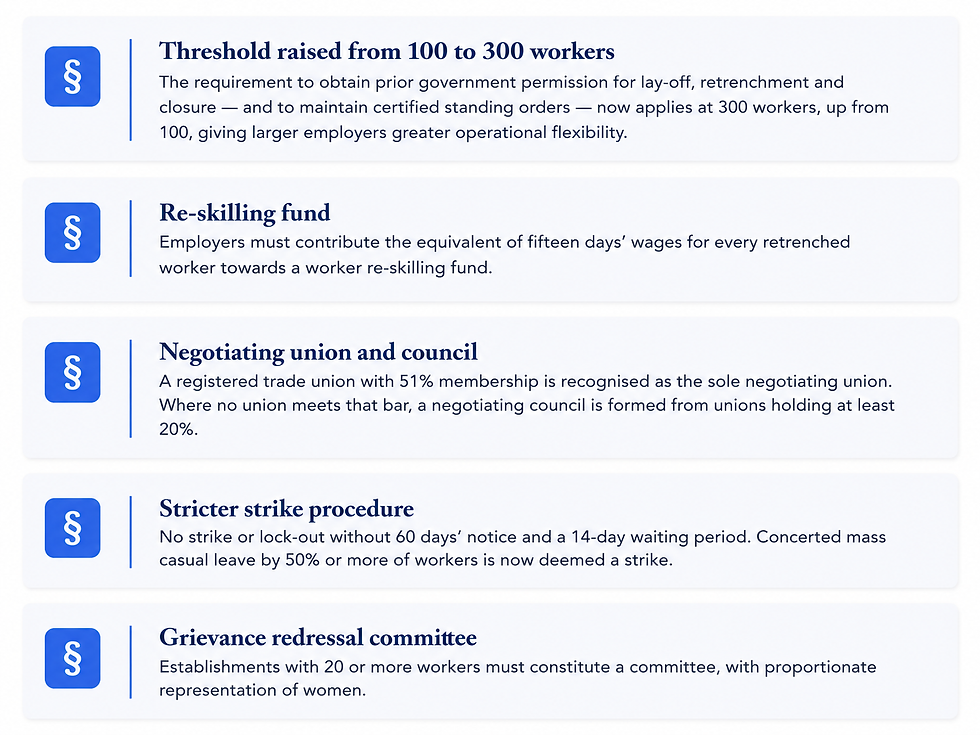
The Industrial Relations Code rebalances several long-standing thresholds while formalising the machinery of dispute resolution.
05. Social security, safety and the workplace
The Code on Social Security extends coverage in ways that matter well beyond the traditional factory floor. Gig and platform workers are brought within the social-security net for the first time, with aggregator contributions and a dedicated framework — the detailed contribution rules for this segment are among the items still being finalised and will be a defining next chapter. Registration is moving to an Aadhaar-linked, universal model.
On the safety and conditions side, the OSH Code consolidates the old factory-and-contract-labour regime into a single registration, single licence and single return, reducing duplicative filings. Two practical obligations deserve attention: appointment letters are now mandatory for every employee, and establishments must provide free annual health check-ups for workers above the age of 40. Women are permitted to work in all establishments, including night shifts, subject to consent and prescribed safeguards.
06. Where things actually stand — and why timing matters
It is essential to distinguish “effective” from “fully enforceable”. The codes themselves are in force. But labour is a subject on the Concurrent List, which means both the Centre and each State must notify rules before every provision becomes operational in a given State. The picture today is a transition in motion:

The practical takeaway: the precise compliance obligation in your State, on a given provision, depends on what the State has notified. This is exactly the kind of moving target where careful, jurisdiction-specific advice prevents both over-compliance and exposure.
07. What employers should do now
You do not need to wait for the last State notification to begin. The high-impact work is preparatory, and the organisations that handle this well are starting it now.

A note from Vatsal Mashar
The labour codes are not merely a compliance update — they reshape the economics of employment, the structure of contracts, and the procedure for handling disputes. Most of the cost and risk in this transition is avoidable with the right preparation, and most of the friction comes from treating it as a one-time filing rather than a structural change.
At Mashar Associates we are helping organisations move from the old regime to the new one end to end — pay-structure restructuring, contract and policy overhauls, standing orders, committee constitution, and State-specific compliance mapping. If you would like a readiness review for your organisation, we would be glad to assist.
Comments